Claude Opus 4.7 Ships: SWE-bench Pro Leader at Unchanged Pricing
Anthropic released Claude Opus 4.7 on April 16, scoring 64.3% on SWE-bench Pro—ahead of GPT-5.4 (57.7%) and Gemini 3.1 Pro (54.2%)—and 87.6% on SWE-bench Verified. New features include 3x higher image resolution (up to 2,576px), a redesigned tokenizer, task budgets in public beta, and a /ultrareview command in Claude Code. Pricing stays at $5/$25 per million input/output tokens; available via Claude plans, Amazon Bedrock, Vertex AI, and Microsoft Foundry.
OpenAI Agents SDK Gets Sandbox Execution and Frontier Model Harness
OpenAI shipped the next evolution of its Agents SDK on April 15, adding a sandboxed code execution layer with built-in support for E2B, Vercel, Modal, Cloudflare, Daytona, Blaxel, and Runloop. The updated harness adds configurable memory, Codex-like filesystem tools, and sandbox-aware multi-agent orchestration. Python support is GA via the API at standard pricing; TypeScript support is planned in a follow-up release.
Cal.com Goes Closed Source, Citing AI-Powered Attack Surface
Cal.com announced on April 15 that it's relicensing its main scheduling codebase from open source to a proprietary license, arguing that AI coding tools now let attackers scan public repositories for vulnerabilities 100x faster. The company simultaneously launched Cal.diy, a stripped-down MIT-licensed fork for hobbyists. The announcement sparked a 500+ comment debate across two Hacker News threads about open-source sustainability in the AI era.
Google AI Mode in Chrome Gets Split-Screen and Reusable Skills
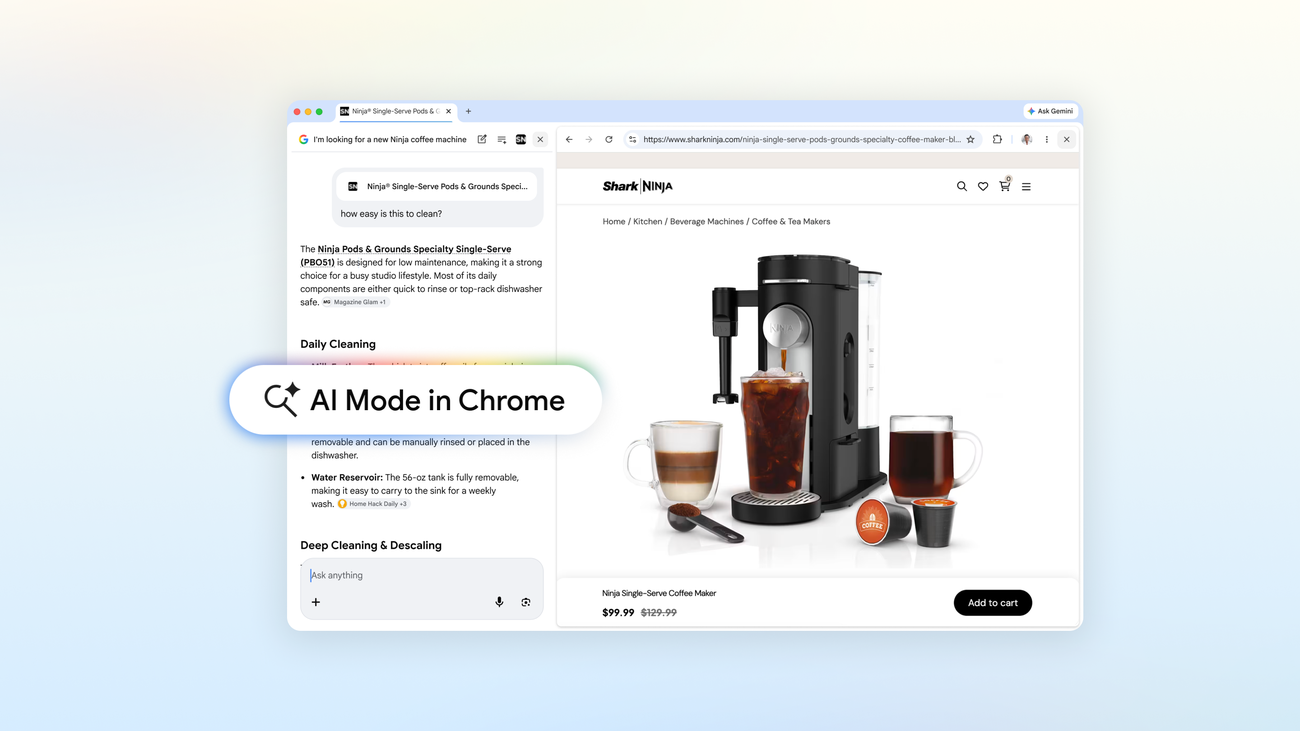
Google rolled out a major AI Mode update in Chrome on April 16, adding split-screen browsing (linked pages open side-by-side with the AI panel), cross-tab search (use any open tab or PDF as context), and AI Skills (save and replay custom prompts one-click across any page). The update is live now for English US users on Chrome desktop, Android, and iOS.
NVIDIA Launches Ising: First Open AI Models for Quantum Processor Calibration
NVIDIA released Ising on April 15, the first open model family purpose-built for quantum processor calibration and error correction. The 35B-parameter Ising Calibration model compresses multi-day manual calibration workflows to hours, and Ising Decoding achieves 3x higher accuracy and 2.5x faster throughput on real-time quantum error correction versus existing tools. Both models and training code are on Hugging Face under an open license; adopters include IonQ, IQM, Fermi National Lab, and Harvard.
